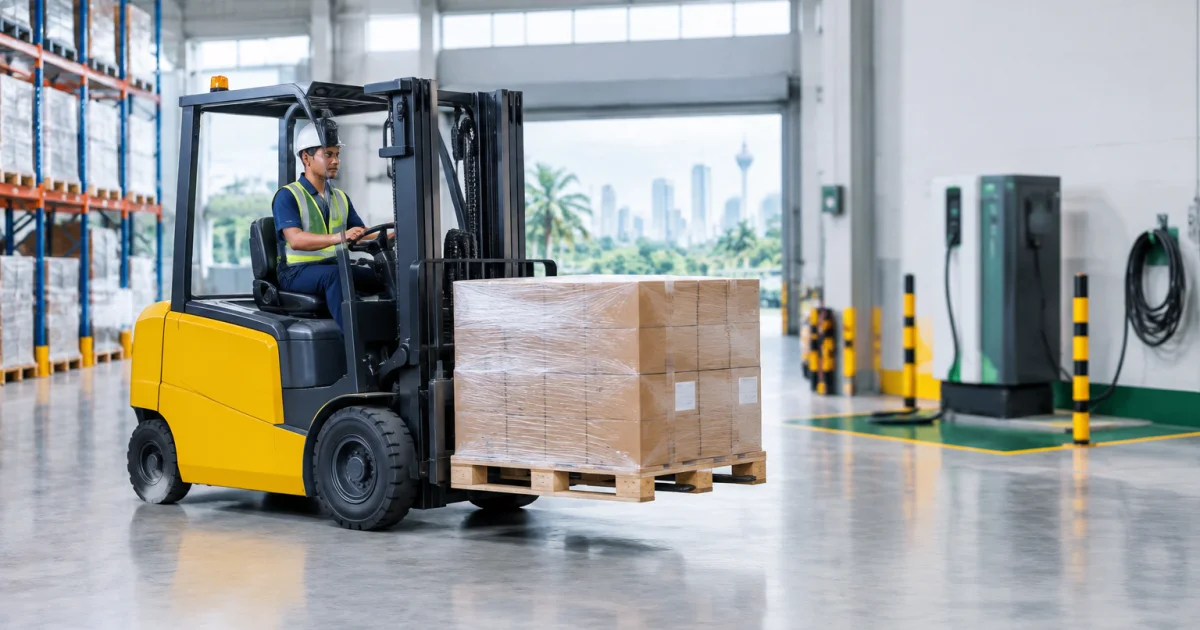
When Sabah warehouse and factory teams compare forklifts, purchase price often dominates the discussion because it’s visible and easy to approve. But over the life of the truck, the “cheaper” option upfront can cost more in energy, repairs, and lost uptime.
That’s why an Electric Forklift Sabah decision should be judged mainly on total cost of ownership (TCO)—not sticker price, and not sustainability alone. Sustainability is a bonus; TCO protects margins.
Use the Sabah-relevant guide below to evaluate TCO across energy, maintenance, uptime, battery planning, and whether rental or reconditioned units reduce risk.
What “total cost of ownership” really means for a forklift
TCO is the full cost of keeping a forklift available to do its job over a set period (commonly 3–7 years). In practical terms: “What will this forklift really cost us to run?”
For most Forklift Sabah buyers, TCO typically falls into five buckets:
- Acquisition: truck price (new/used/reconditioned), delivery, attachments, required add-ons.
- Energy: diesel/petrol consumption vs electricity usage and charging losses.
- Maintenance & repairs: scheduled servicing, wear items, breakdowns, parts, labour, call-outs.
- Downtime: cost when a truck is unavailable (missed loading windows, overtime, disruptions, extra manpower).
- End-of-life: resale value, battery replacement timing (electric), disposal/transition costs.
If you compare only acquisition, you can miss what usually drives long-term cost: energy, maintenance complexity, and especially downtime—more so with high utilisation, shift work, or tight dispatch schedules.
Energy cost: the quiet budget leak in diesel operations
Diesel spend is easy to record but hard to control because it changes with utilisation, idling, load patterns, and operator habits. Energy cost is often inflated by:
- Idling during staging (waiting at bays, queues, traffic inside compounds)
- Stop-start cycles (high consumption relative to work done)
- Operator behaviour variance (throttle habits swing monthly spend)
- Fuel handling time (refilling processes, controls, potential wastage)
Electric shifts the question from fuel to charging. Site electricity rates and infrastructure matter, but a key advantage is predictability: many operations can forecast charging costs more reliably than diesel spend when idling and utilisation vary.
Electric powertrains also deliver consistent low-speed torque, which fits common warehouse work (positioning, short runs, repetitive cycles) and can reduce wasted energy even without perfect driving discipline.
Where electric’s energy advantage is most noticeable
- Indoor warehouses with frequent short runs, stops, and staging time
- Multi-shift or extended hours where energy spend compounds
- Sites that can standardise charging (end-of-shift routines or controlled opportunity charging)
Electric is not automatically cheaper for every application. Heavy outdoor work, long travel distances, and harsh conditions can still favour internal combustion. The common mistake is running diesel by default even when the real duty cycle is mostly indoor or mixed use with moderate loads.
Maintenance and repairs: fewer “moving parts” often means fewer surprises
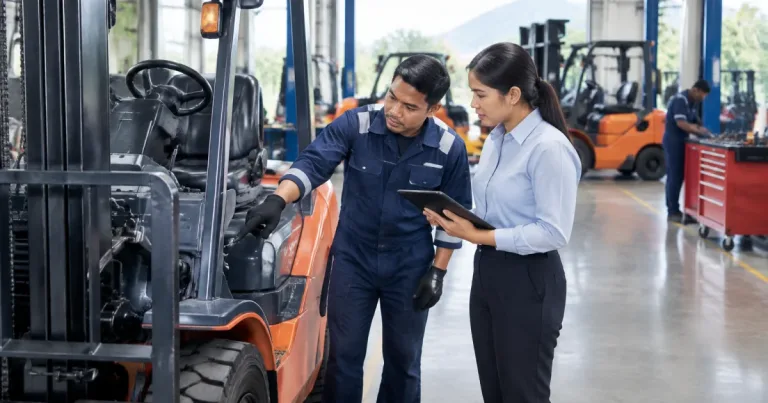
Maintenance is where the TCO gap often widens. Diesel engines add service items and systems that age over time (oil, filters, belts, cooling components). Even if each service is manageable, the cumulative downtime matters.
Electric forklifts generally have fewer drivetrain wear components. That doesn’t mean “no maintenance”—tyres, brakes, hydraulics, chains, mast rollers, and inspections still apply—but day-to-day power system maintenance is often simpler.
The decision-maker question isn’t only the service interval. It’s whether the truck causes unplanned stops—and how fast you can recover.
How often will this truck create an unplanned stop in the middle of our operation, and how quickly can we recover?
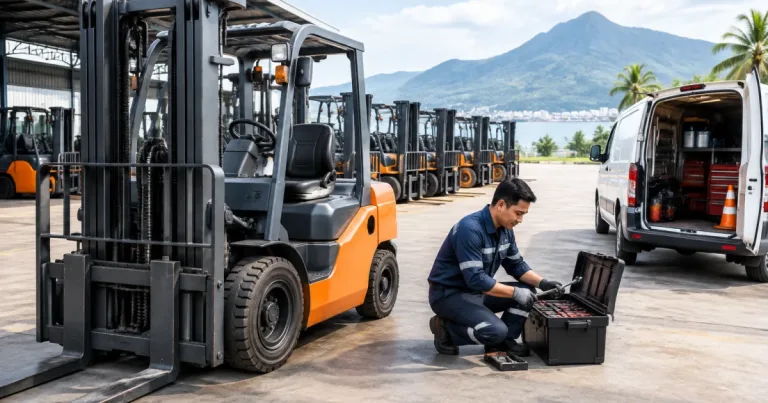
Unplanned downtime creates hidden costs: labour waiting time, rescheduling, extra handling steps, or using the wrong equipment to keep production moving. If your team is frequently searching “repair forklift near me,” downtime is already a real operational problem—not just a maintenance line item.
A simple maintenance TCO checklist (practical, not theoretical)
- Do you have a preventive maintenance plan with clear intervals and inspection items?
- Is there a service response process that matches your operating hours?
- Can you get spare parts without long delays?
- Do you have a plan for tyre wear and floor conditions (a major cost driver for any forklift)?
- Is the spec correct (capacity, mast height, attachments) so the truck isn’t being overworked?
Battery strategy: the make-or-break factor for electric forklift TCO
Battery uncertainty often stalls “electric vs diesel” discussions. Treat the battery as an asset with a clear operating plan and electric becomes easier to manage.
Battery strategy affects TCO through:
- Runtime per charge vs shift length and peak periods
- Charging method: end-of-shift charging vs opportunity charging
- Battery care discipline (routines that protect battery health)
- Replacement timing and whether it’s planned within your ownership horizon
Lithium-ion models can simplify charging routines and reduce operational friction. Lead-acid can also work well when charging areas and schedules are controlled. The right choice depends on utilisation, layout, and how much you value fast turnaround versus lower upfront cost.
Instead of “is lithium better?”, ask “what does our day look like?” Map shift hours, peak loading windows, and the consequence of a truck being unavailable, then choose the battery approach that best protects uptime.
Infrastructure reality check: charging space and power
You don’t need a massive charging room to start (especially for small fleets), but you do need a safe, consistent plan: a dedicated charging point, clear cable management, ventilation where relevant, and simple procedures operators can follow.
If you’re already improving your warehouse—racking, aisles, reach equipment, traffic flow—align forklift selection with the material handling plan so the truck supports the layout. For a wider view, see forklifts in Malaysia and how they support efficiency and safety in logistics.
Downtime, productivity, and operator experience: the “hidden” TCO multipliers
Two businesses can buy the same forklift and end up with very different long-term costs. Uptime and fit-to-task are usually the difference.
Electric forklifts can lift productivity in ways that don’t show clearly in a quotation:
- Consistent performance for indoor cycles, with less vibration and noise for operators
- Simpler start/stop routines that reduce idling and encourage disciplined operation
- Lower friction for indoor compliance (cleaner operation in enclosed spaces)
Diesel can still be the right tool for demanding outdoor yards, uneven surfaces, and long travel distances. But when most work is warehouse handling, electric often matches the environment better—and better match typically means less wasted time.
Operator experience also influences behaviour: smoother driving, better pallet placement, fewer impacts, and less damage to racking or goods. Pair the right forklift with operator training and clear operating rules to reduce avoidable incidents that quietly inflate TCO.
Buy vs rent vs reconditioned: picking the lowest-risk path in Sabah
TCO is also shaped by ownership model. Some operations simply need reliable capacity for the next 12–36 months; rental or a reconditioned unit can be lower-risk than buying brand new.
A practical decision guide:
- Buy (new) when utilisation is predictable, you’ll keep the unit long-term, and the spec is stable.
- Buy (reconditioned) when you want ownership with lower upfront cost and have a trusted supplier for parts and service.
- Rent when demand is seasonal, you’re proving a workflow, you need short-term capacity, or you want to test electric before committing.
Rental can also hedge downtime. If you can’t afford to wait during repairs, a rental arrangement—or a supplier that can provide temporary replacements—can stabilise operations. It’s why many people search “forklift rental near me” when equipment issues threaten production.
For a side-by-side framework, see Electric Forklift Vs Diesel Forklift: which is better for your business. For Sabah-specific availability and support coverage, Forklift Sabah is a useful starting point. If diesel is still the right fit for your yard, spec it correctly and plan maintenance tightly; options are here: Diesel Forklift.
A practical TCO comparison you can run internally (no complex spreadsheet needed)
You don’t need perfect numbers—just a fair comparison that reflects how your operation actually runs. A simple method procurement and operations can align on:
- Define the duty cycle: indoor/outdoor split, average load, travel distance, hours per day, shifts per week.
- List must-have specs: capacity, lift height, mast type, tyre type, attachments, aisle-width constraints.
- Estimate monthly energy use: based on hours and realistic utilisation assumptions (ask suppliers for their basis).
- Estimate maintenance approach: preventive intervals, typical wear items, and breakdown response responsibility.
- Assign a downtime value: even a rough figure (overtime, missed dispatch, slowed production when one truck is down).
- Choose an ownership period: 3 years for changing needs, 5–7 years for stable operations.
- Compare scenarios: electric buy vs diesel buy; electric rental vs diesel rental; reconditioned vs new.
Diesel tends to “win” only when you assume downtime is minimal and maintenance is consistently smooth. If that doesn’t match reality, electric can become compelling even before you assign value to sustainability.
Conclusion: in Sabah, TCO often favours electric earlier than people expect
Diesel forklifts have a clear place—especially for outdoor, heavy-duty, long-travel applications. But many warehouses and factories in Sabah use diesel by default, not because it’s been proven cheaper over time for their duty cycle.
If your work is predominantly indoor or mixed use with predictable routes, and you want more controllable operating costs with less disruption, evaluate electric through TCO. When you account for energy predictability, maintenance complexity, and the true cost of downtime, electric can beat diesel earlier than many teams expect.
The best next step isn’t debating what’s “better” in general—it’s matching the truck, battery plan, and support model to your operation so the forklift becomes a stable part of your workflow rather than a recurring surprise.
Frequently Asked Questions
Is an electric forklift really cheaper than a diesel forklift in Sabah?
It can be, depending on your duty cycle. Electric forklifts often reduce operating cost through more predictable energy spend, simpler drivetrain maintenance, and fewer disruption events. Diesel may still be cost-effective for heavy outdoor work with long travel distances, but many indoor or mixed-use operations find electric wins when total cost of ownership (including downtime) is compared fairly.
What costs should I include when comparing total cost of ownership (TCO)?
Include acquisition (truck and attachments), energy (diesel/petrol vs electricity), preventive maintenance and repairs, downtime impact (lost productivity or overtime), and end-of-life items such as resale value and potential battery replacement. A good comparison uses the same ownership period (for example 3–7 years) across options.
Do I need a special charging room to run electric forklifts?
Not necessarily. You do need a safe, consistent charging point and clear procedures: a designated area, tidy cable management, basic safety signage and controls, and a routine operators can follow. The exact setup depends on fleet size, shift pattern, and whether you use end-of-shift charging or opportunity charging.
Should I buy, rent, or choose a reconditioned forklift?
Buy when utilisation is predictable and you plan to keep the truck long-term. Choose a reconditioned unit when you want ownership with a lower upfront cost and strong after-sales support. Rent when demand is seasonal, you’re launching a new workflow, you need short-term capacity, or you want to test electric forklifts before committing.
Can one supplier handle forklift sales, rental, and repair services?
Yes—many operations prefer a single partner to simplify accountability and reduce downtime. Working with a supplier that supports forklift sales, rental, repair, spare parts, and preventive maintenance can make TCO more controllable because service response and replacement options are clearer when issues occur.
Plan your lowest-TCO forklift setup with AM Forklift Sdn. Bhd.
If you’re weighing electric versus diesel for your Sabah operation, AM Forklift Sdn. Bhd. can help you compare options based on your real duty cycle—hours, loads, aisles, charging practicality, and service coverage. We supply new and reconditioned forklifts, electric and lithium solutions, diesel models, rentals, repairs, preventive maintenance, and operator training—so you can choose the setup that keeps uptime high and costs predictable.