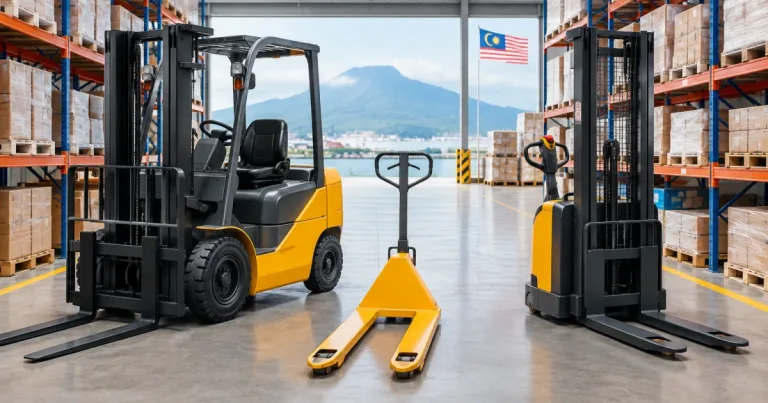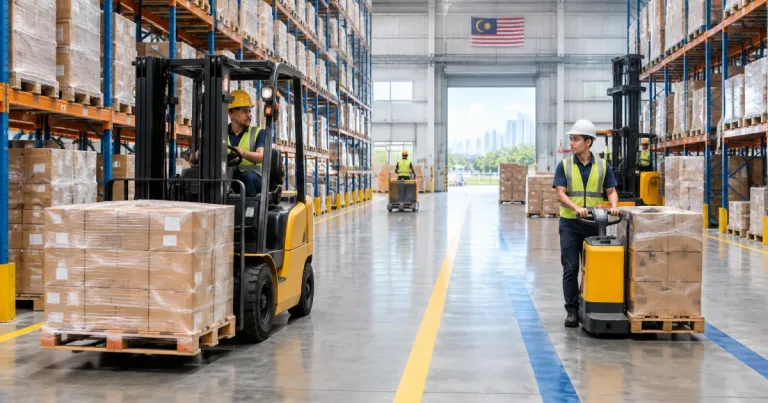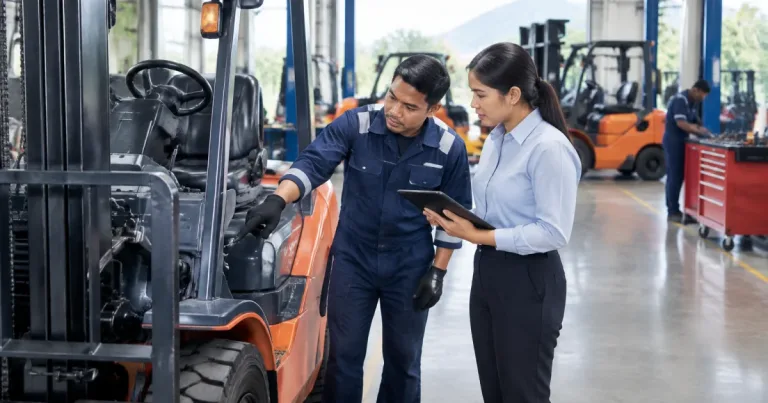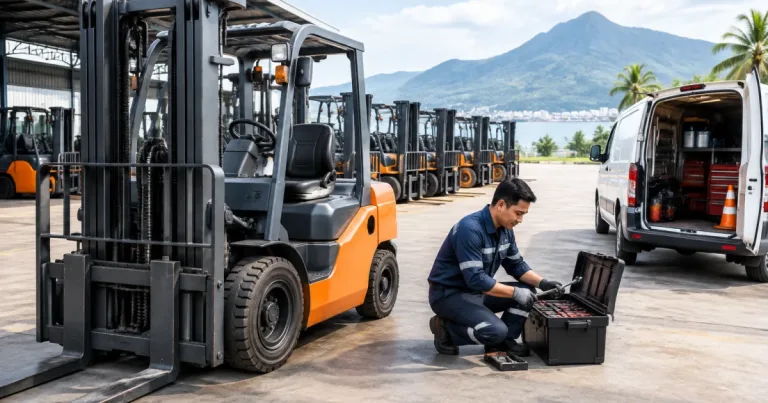
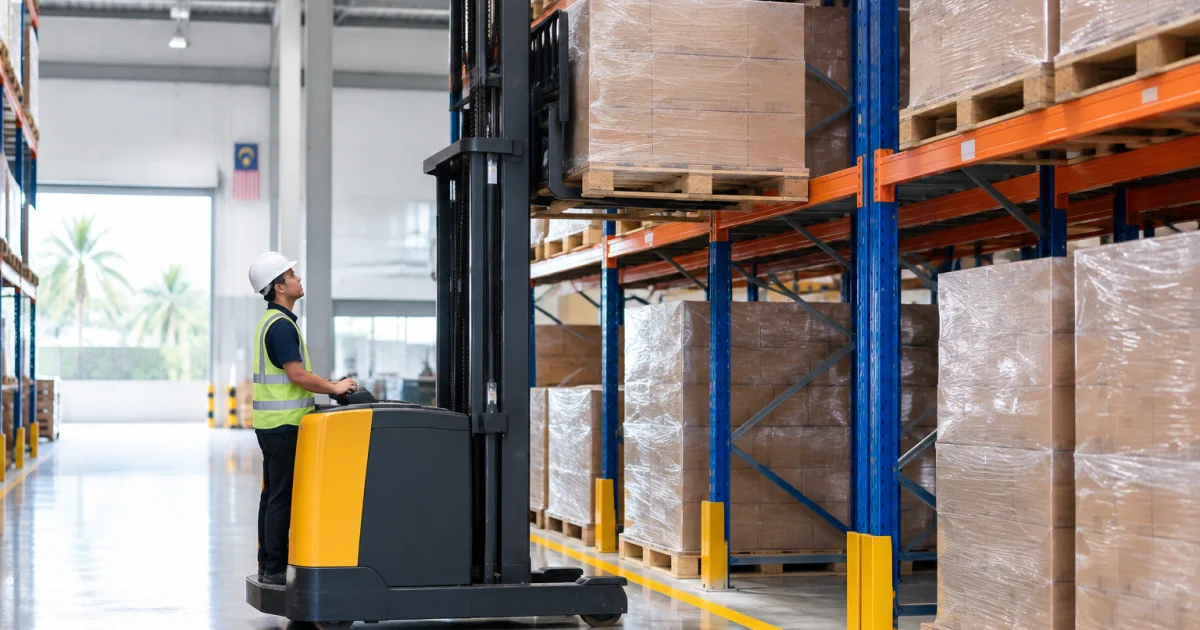
Stackers sit in a practical middle ground: more capable than a hand pallet truck, less complex (and often more affordable) than a counterbalance forklift. For Malaysian warehouses and SMEs, the right stacker can increase storage density, improve indoor handling safety, and speed up put-away—if it matches your aisle width, required lift height, and pallet type.
This commercial selection guide is for warehouse supervisors and business owners comparing stackers vs pallet trucks and wanting a clear path from “our warehouse layout” to “this is the stacker specification we should request.” The same selection logic applies when sourcing through partners and branches—for example when planning a fleet for Forklift Sabah operations where service support and parts availability matter as much as headline capacity.
Below, you’ll learn how to translate racking, floor quality, pallet mix, throughput, and operator skill into a shortlist of stacker options. We’ll also define key supplier terms (load centre, residual capacity, free lift), highlight common pitfalls, and provide RFQ examples you can copy.
1) Start with your workflow: what a stacker must do (and what it shouldn’t)
Clarify the job before comparing models. Stackers are best for indoor, light- to medium-duty work with frequent short travel and repeated lift/lower cycles—receiving, staging, packing, and racking aisles. They can lift pallets to low- and mid-level beams (and higher with the right mast), but they’re not designed to replace higher-performance forklifts in demanding environments.
They are often the wrong tool for long outdoor travel, rough or uneven yards, frequent ramp work, or heavy handling near the limit of rated capacity for long shifts. In those cases, an internal combustion forklift or larger electric forklift usually offers better stability and performance margins.
Typical stacker tasks that fit well
- Loading/unloading pallets from ground level to racking
- Staging pallets for picking and dispatch
- Feeding production lines with palletized materials
- Short-distance moves on smooth floors
- Occasional container work (with the right model and floor conditions)
Signs you may need a different solution
- Very heavy loads at/near maximum capacity for long shifts
- Long-distance, higher-speed travel—especially outdoors
- Uneven/damaged floors, frequent wet/oily areas, or poor traction
- High-level racking close to mast limits with strict placement accuracy
- Very wide or non-standard pallets that reduce stability
Often the best answer is “stacker plus another tool.” A stacker can handle put-away and storage while a powered pallet truck covers longer horizontal travel, reducing total cost versus forcing one machine to do everything.
2) Aisle width: the fastest way to eliminate the wrong stacker
Aisle width is the quickest filter because turning radius and operating clearance determine whether operators can work safely without constant shunting (multi-point turns) that reduce throughput and increase racking strikes.
Measure the working aisle width, not just paint-to-paint. Include:
- Racking overhangs, protectors, and pallet overhang beyond beams
- Columns and fixed obstructions (hose reels, cabinets, etc.)
- Typical congestion (people, trolleys, pickers)
Also define the method: turning 90° into a bay needs different space than approaching straight into a lane.
Walkie vs ride-on: how it changes your aisle requirement
Walkie (pedestrian) stackers need clearance for the operator’s position and safe walking path, not only the chassis footprint. They can still work well in narrow aisles, but visibility and body clearance must be planned.
Ride-on stackers (platform/stand-in) improve throughput on longer runs, but higher travel speeds and riding position typically require stronger traffic control and more conservative safety margins in tight aisles.
Practical aisle checks you can do without special tools
- Cardboard mock-up: Mark the pallet footprint plus expected overhang and simulate turning into/out of bays.
- Two-pallet test: Place one pallet in the bay and one in the aisle as a worst-case obstruction—can the truck pass safely?
- Operator sightline test: From the operator’s position, confirm clear view of fork tips and rack beams during final approach.
If space is tight, consider initial lift (for dock plates), narrower chassis options, or revisiting aisle layout. For high-density goals, racking geometry and truck choice must be decided together.
3) Lift height and racking: rated capacity isn’t the whole story
Buyers often compare “maximum lift height” and “rated load.” In practice, you need residual capacity at your working height and stable, accurate placement at height without overloading the mast or compromising stability.
Key racking measurements to collect
- Top beam height you actually use (not just overall rack height)
- Clearance needed for pallet + load height and safe placement
- Under-clearance at doors, mezzanines, sprinklers, and overhead services
- Floor flatness and slopes in the working aisles
Understanding “free lift” and why it matters
Free lift is how far the forks rise before the mast extends upward. It matters when you must lift under low overhead clearance (containers, low doors, sprinklers). Free lift helps you raise loads while keeping overall mast height lower, reducing the risk of overhead contact.
Load centre: the hidden variable that changes capacity
Capacity is usually rated at a standard load centre (often 500 mm). If your loads are longer/deeper or weight is farther from the fork face, the load centre increases and effective capacity drops—especially with bulky cartons, uneven loads, or non-standard pallets/skids.
Actionable step: in your RFQ, state typical pallet weight and load dimensions (length/depth). Ask the supplier to confirm residual capacity at your required lift height and your actual load centre.
4) Pallet types in Malaysia: match forks, outriggers, and straddle to what you really handle
Pallet variety is a common cause of “right capacity, wrong truck.” The base design—outriggers, support legs, and straddle legs—determines what pallets you can pick up and how close you can approach racking.
Common pallet scenarios and what they imply
- Standard 2-way entry pallets: Confirm fork spacing and entry clearance; deck boards can block access.
- 4-way entry pallets: Generally easier, but check underside design and stringer/runner clearance with outriggers.
- Euro/industrial variants: Confirm fork length and adjustment range.
- Plastic pallets: May flex; check load support and fork tip snagging risk.
- Open-bottom vs closed-bottom: Closed-bottom designs can interfere with straddle legs/support legs.
Straddle stacker vs fork-over (support leg) stacker
Straddle stacker: Adjustable legs sit outside the pallet, often more versatile for mixed pallet widths. Trade-offs: added overall width and potential conflicts with racking baseplates or floor obstacles in very tight aisles.
Fork-over / support leg stacker: Fixed support legs with forks that may pass over them. Efficient with consistent pallets and can offer strong stability, but can be limiting with closed-bottom pallets or designs that clash with the legs.
Actionable step: take photos of your pallets (top and underside) and measure entry height. Send them with your RFQ so the supplier can confirm fork dimensions, leg spacing, and any required configuration.
Racking compatibility check
For racking work, confirm the stacker can approach the bay without legs or chassis contacting:
- Rack uprights/protectors
- Baseplates, shims, and anchors
- Low beams, pallet supports, and expansion joints
If you’re still selecting or upgrading racking, align decisions with a broader Material Handling Equipment Malaysia plan so racking geometry, forklifts, stackers, and pallet trucks work together.
5) Power source and duty cycle: electric, lithium-ion, and charging realities
Most modern stackers are electric; the real decision is how your warehouse runs: shift length, charging windows, and operator discipline. Matching the stacker to your duty cycle reduces downtime and extends battery life.
Lead-acid battery: proven, but depends on discipline
Lead-acid can be cost-effective and widely supported, but performance depends on correct charging routines. Frequent deep discharge, missed equalization (where applicable), or poor water-level management (wet-cell) reduces lifespan and reliability.
Lithium-ion: uptime and convenience advantages
Lithium-ion supports opportunity charging and more consistent performance across a shift. It can fit well when you have short breaks for charging, limited space for battery changing, or higher throughput where voltage drop would slow operations.
If you’re comparing lithium options across larger trucks as well, see Lithium Battery Forklift for context on how lithium solutions are positioned across different sizes.
Charging and electrical planning questions to ask
- Where will the charger sit, and is ventilation adequate?
- Do you have stable power and suitable sockets/circuit protection?
- How will you manage cables to avoid trip hazards?
- Do you need fast charging or standard overnight charging?
If your operation mixes stacking with longer runs, it may be more efficient to combine a stacker with a power pallet truck. For fast horizontal transport, compare options in Pallet Trucks and choose each tool for what it does best.
6) Safety and stability: what changes as you go higher (and why training matters)
Stackers may look simple, but stacking at height reduces safety margins. Small issues—slopes, uneven pallet boards, off-centre loads—become significant risks. Good selection helps, but safe outcomes depend on process and training.
Stability basics you should build into your SOP
- Keep loads low while travelling for stability and visibility.
- Square up before lifting; avoid turning with a raised load.
- Use correct fork spacing to support the pallet properly.
- Respect residual capacity; rated load may not apply at working height.
- Control speed in aisles; rushed manoeuvres cause most racking damage.
Visibility and operator position
Travel direction and operator position (load leading vs handle leading) should match the stacker type, aisle rules, and load height. In mixed pedestrian environments, add controls like marked walkways, mirrors, and one-way traffic where possible.
Why professional operator training is part of the purchase decision
Even the best-spec machine can be misused. Training improves stacking accuracy, daily checks, and battery/charging habits. If you run multiple truck types, standardized training reduces “assumed knowledge” gaps between operators.
For a broader safety-aligned strategy, see Choosing The Right Material Handling Equipment For Your Business In Malaysia A Comprehensive Guide.
7) Spec checklist: what to request in a quotation (with examples)
To compare offers fairly, request comparable specs and operating assumptions. This checklist reduces surprises during delivery and commissioning.
Core operating requirements
- Load: typical weight (kg) and maximum occasional load
- Load dimensions: pallet length/depth and typical load height
- Lift height: highest beam you must place onto, plus required clearance
- Aisle width: narrowest working aisle (include obstacles)
- Travel distance: average run per move (short/medium/long)
- Floor conditions: smooth/rough, slopes, dock plates, expansion joints
- Environment: indoor only, cold room, wet zones, dust
Truck configuration and options
- Type: walkie, ride-on platform, straddle, support-leg, counterbalanced stacker (if needed)
- Mast: duplex/triplex, free lift requirement, collapsed mast height limit
- Forks: length, width, thickness, adjustability, special pallet requirements
- Battery: lead-acid or lithium-ion, desired runtime, charging method
- Wheels: polyurethane/other material for your floor and noise needs
- Safety: speed control, horn, warning light (if applicable), stability aids
Support and lifecycle questions (often ignored, but crucial)
- Recommended preventive maintenance schedule
- Typical wear parts and local availability
- On-site service coverage for your area (including East Malaysia if needed)
- Lead time for major components (controllers, motors, chargers)
- Site assessment and operator familiarization options
Practical RFQ examples
Example A: Narrow aisle put-away
“We need a pedestrian stacker for indoor racking. Aisle width ~2.6 m with occasional pedestrian crossing. Highest storage beam is 4.5 m. Typical pallet 800–1000 kg, 4-way entry. Please recommend a suitable mast with enough free lift for 2.2 m doorways.”
Example B: Mixed pallets with frequent staging
“We handle mixed wooden and plastic pallets. Some are closed-bottom. We need a solution that can pick and stage pallets at 3.0 m height and also travel 40–60 m per move. Please propose straddle/support-leg options and clarify pallet compatibility.”
Example C: High-uptime operation
“Operation runs extended hours with limited downtime. We prefer lithium-ion for opportunity charging. Please specify expected runtime for our average 600 kg pallet moves and required charger specifications.”
8) Buying vs renting vs reconditioned: choosing the right commercial path
After confirming technical fit, choose the commercial model that matches your risk profile and cash flow. Malaysian SMEs commonly consider new purchase, reconditioned units, or rental depending on project duration and uptime needs.
When buying new makes sense
- Mission-critical daily use
- Standardization across multiple sites
- Predictable supportability and clear maintenance history
When reconditioned can be a smart option
- Moderate usage with a clear inspection/service plan
- Better cost control while still meeting spec
- Gradual capacity expansion versus full fleet replacement
When rental reduces risk
- Seasonal, project-based, or uncertain demand
- Trialling a stacker type before committing
- Immediate replacement while waiting for purchase lead times
If you’re also comparing broader forklift categories, Electric Forklift Vs Diesel Forklift Which Is Better For Your Business explains how powertrain choices affect operating patterns and costs. For storage density projects with fast movers, Flow Rack Pallet Live Storage System shows how racking design can reduce travel time and change the equipment mix.
Conclusion: a simple way to reach the right stacker shortlist
The fastest path to the right stacker is turning your warehouse reality into three constraints:
- Aisles: the narrowest workable space including safe operator clearance
- Lift height: the highest beam you actually use, plus residual capacity at that height
- Pallet types: underside design, entry height, and width that determine straddle/support-leg compatibility
Once these are clear, choose the stacker format (walkie vs ride-on, straddle vs support leg), then refine mast configuration, battery type (lead-acid vs lithium-ion), and the support plan that keeps uptime high. If you’re coordinating multiple sites or regions—such as supply and service planning for Forklift Sabah alongside Peninsular locations—prioritize suppliers who can assess the site, align spec to your racking, and back it up with parts and maintenance support.
Use the RFQ checklist above, compare like-for-like specs, and get pallet and racking compatibility confirmation in writing. It typically saves more time and cost than negotiating a slightly lower headline price on a mismatched truck.
Frequently Asked Questions
What’s the difference between a stacker forklift and a power pallet truck?
A stacker forklift (stacker) is designed to lift pallets to storage heights (for example into racking) as well as move them short distances. A power pallet truck is mainly for horizontal transport at floor level and typically cannot place pallets onto higher rack beams. Many warehouses use both: the pallet truck for longer travel and the stacker for put-away and stacking.
How do I choose the right lift height for a stacker in racking?
Start with the highest rack beam you need to use, then add clearance for the pallet and load height. Ask the supplier to confirm residual capacity at that working height (not only the rated capacity at a lower height). Also check collapsed mast height and free lift if you have low doors, low ceilings, or need to work inside containers.
Can one stacker handle different pallet types (wooden, plastic, 2-way, 4-way)?
Sometimes, but compatibility depends on the pallet underside and the stacker’s leg design. Straddle stackers can be more flexible for mixed pallet widths, while support-leg designs may be better for consistent pallet types. Provide pallet dimensions and photos of the underside so the supplier can confirm fork size, leg spacing, and whether closed-bottom pallets will cause interference.
Is lithium-ion worth it for a stacker in Malaysia?
Lithium-ion can be worth it when uptime and convenience matter—especially if you can opportunity-charge during breaks and you want consistent performance through the shift. Lead-acid can still be cost-effective if your operation supports disciplined charging routines and you have predictable downtime for charging.
Do suppliers provide rental, sales, and repair services for stackers and forklifts?
Many do, and it’s often a smart way to reduce risk. Renting can help you cover seasonal demand or trial a stacker type before buying. When comparing suppliers, ask what maintenance support is included, parts availability, response time expectations, and whether they can support your site location (including East Malaysia where applicable).
Need help matching a stacker to your aisles, lift height, and pallets?
AM Forklift Sdn. Bhd. supplies electric pallet jacks and stackers, new and reconditioned forklifts, lithium battery solutions, and warehouse racking systems—supported by rental, repair, preventive maintenance, spare parts, and operator training.
Share your aisle width, racking beam height, and pallet photos, and our team can help you shortlist the right stacker configuration and support plan for your operation.